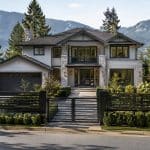

The answer depends heavily on whether you choose a framed, semi-frameless, or frameless glass railing system. If you need glass railing in north Vancouver, west Vancouver at competitive prices, contact us at Lions Gate Railings now.Based on published Vancouver-area pricing in 2026, homeowners can generally use $150 to $400+ per linear foot installed as a broad planning range for standard glass railing projects.
Framed aluminum-and-glass systems usually sit toward the lower end, while custom frameless glass railings tend to cost more because of heavier glass, specialized hardware, more precise measurements, mounting requirements, and installation complexity.For homeowners in Vancouver, North Vancouver, and West Vancouver, cost is not the only consideration.
Views, architectural style, exposure to coastal weather, deck construction, stairs, and local building requirements can all influence which railing system makes the most sense.
Glass Railing Cost in Vancouver at a Glance
The following ranges are useful for early budgeting. They reflect published Vancouver-area market pricing rather than a fixed quote from Lions Gate Railings. Actual prices should be confirmed after the property and supporting structure are assessed.
| Glass Railing Type | Typical Published Vancouver-Area Range | Best Suited For | Relative Cost |
|---|---|---|---|
| Framed Glass Railing | $150–$275 per linear ft | Decks, family homes, commercial areas, renovations | $ |
| Semi-Frameless Glass Railing | $250–$350 per linear ft | Residential decks and balconies where views and budget both matter | $$ |
| Frameless Glass Railing | $300–$400+ per linear ft | Luxury homes, view properties, contemporary architecture | $$$ |
These figures should be treated as budgeting ranges rather than guaranteed prices.
Stair sections, difficult access, structural upgrades, engineering, custom glass shapes, premium finishes, demolition of old railing, and unusual mounting conditions can increase the final cost.
How Much Does a Frameless Glass Railing Cost in Vancouver?
A professionally installed frameless glass railing in Vancouver commonly falls around $300 to $400 per linear foot based on current published local pricing. More complicated projects can exceed that range.
Frameless systems minimize visible posts and framing so that the glass becomes the dominant visual element.
Depending on the design, the glass may be secured using a base shoe, standoffs, specialized clamps, or other engineered mounting systems.
This makes frameless railing especially attractive where preserving a view is a major goal. On a West Vancouver deck overlooking Burrard Inlet, for example, reducing vertical posts can make a significant visual difference.
Why Is Frameless Glass More Expensive?
- Thicker or more specialized safety glass may be required.
- Measurements and glass fabrication must be extremely precise.
- Mounting hardware is generally more specialized.
- The supporting deck, concrete, fascia, or stair structure must be suitable for the selected anchoring system.
- Custom corners, stairs, slopes, and changes in elevation require additional design work.
- Some top-rail-free or highly minimal systems may require project-specific engineering and approval.
How Much Does a Framed Glass Railing Cost in Vancouver?
A framed glass railing generally uses aluminum posts and rails around or between the glass panels.
Published local pricing indicates that many framed aluminum-and-glass systems fall approximately between $150 and $275 per linear foot installed, depending on the system and project.
Framed glass railing still provides excellent visibility, but the posts and rails create more visual structure.
For many residential and commercial projects, this is a good trade-off because the system can be more economical while still providing a clean and modern appearance.
Framed railing can be particularly practical for family homes, townhouses, rental properties, commercial spaces, and renovations where budget, durability, replaceable panels, and straightforward installation are important.
Frameless vs. Framed Glass Railing: Cost Comparison
| Feature | Frameless Glass | Framed Glass |
|---|---|---|
| Typical Vancouver-area price | $300–$400+ / linear ft | $150–$275 / linear ft |
| View obstruction | Very low | Low to moderate |
| Visible posts | Minimal or none, depending on system | Yes |
| Architectural style | Minimalist and contemporary | Modern to traditional |
| Installation complexity | Generally higher | Generally lower |
| Custom fabrication | Usually more extensive | Often more standardized |
| Best for panoramic views | Excellent | Good |
| Budget-friendly option | No | Yes |
| Common applications | Luxury decks, balconies, modern stairs | Decks, balconies, stairs, commercial areas |
Example Glass Railing Budgets
To understand how the per-foot difference affects a complete project, consider these simple examples.
They are based only on the published planning ranges above and do not include every possible project-specific expense.
| Railing Length | Framed Glass at $150–$275/ft | Frameless Glass at $300–$400/ft |
|---|---|---|
| 20 linear ft | $3,000–$5,500 | $6,000–$8,000 |
| 30 linear ft | $4,500–$8,250 | $9,000–$12,000 |
| 40 linear ft | $6,000–$11,000 | $12,000–$16,000 |
| 50 linear ft | $7,500–$13,750 | $15,000–$20,000 |
A 30-foot deck, for example, could have a difference of several thousand dollars between a straightforward framed system and a premium frameless installation.
For a property with an exceptional ocean, city, or mountain view, some homeowners consider the additional cost worthwhile.
What Factors Affect Glass Railing Prices in Vancouver?

1. Glass Type and Thickness
Glass used as part of a required guard cannot simply be ordinary window glass.
Applicable building requirements call for appropriate safety glazing, and the exact glass specification depends on the railing design and engineering.
Larger panels, thicker panels, laminated configurations, custom shapes, and specialty finishes can all raise material and fabrication costs.
2. Railing Length
Linear footage remains one of the biggest cost factors. However, a straight 40-foot deck is usually easier to price and install than several short sections totaling the same length.
3. Corners and Changes in Direction
Every corner can require additional glass fabrication, hardware, posts, channels, or mounting work.
A simple rectangular deck usually costs less per foot than an irregular balcony with multiple angles.
4. Stairs
Glass stair railings generally require more detailed measurement than straight deck railings.
Angled glass panels, handrail requirements, landings, and transitions between stair and level guards can increase labour and fabrication costs.
5. Mounting Method
Top-mounted systems, fascia-mounted systems, base shoes, standoffs, and other attachment methods have different material and labour requirements.
The condition of the existing deck structure is also important because the railing is only as reliable as the structure to which it is anchored.
6. Site Access
Glass panels are heavy and must be handled carefully. Properties on steep North Shore lots, upper-level decks, narrow side yards, or locations with limited equipment access may require additional labor.
7. Removal of Existing Railings
Replacing old wood, aluminum, or steel railings can involve demolition, disposal, surface repair, waterproofing coordination, and preparation before the new glass system is installed.
Which Vancouver Neighborhoods Use Frameless Glass Railings More?
There are no municipal statistics that track glass railing installations by neighborhood, so it would be misleading to claim an exact percentage of homes using framed or frameless systems.
However, certain neighborhood and property characteristics strongly influence which system is typically selected.
In general, frameless glass is a stronger fit for modern and view-oriented properties, while
framed or semi-frameless systems are often practical for traditional homes, renovations, multi-family properties, and budget-conscious projects.
| Area / Neighborhood | Glass Railing Style Often Best Suited | Why |
|---|---|---|
| British Properties, West Vancouver | Frameless glass railing | Large luxury homes, contemporary architecture, elevated lots, and panoramic city or ocean views make view preservation especially valuable. |
| Chartwell, West Vancouver | Frameless | Hillside properties frequently place a premium on south-facing city and water sightlines. |
| Dundarave, West Vancouver | Frameless / Semi-Frameless | Ocean-view decks and renovated luxury homes benefit from transparent railing designs that preserve outward views. |
| Ambleside, West Vancouver | Frameless / Semi-Frameless | The area’s combination of view homes, condos, and renovated properties creates demand for both premium and moderately framed glass systems. |
| Deep Cove, North Vancouver | Frameless / Semi-Frameless | Properties overlooking the water, mountains, and surrounding landscape benefit from minimal visual obstruction. |
| Upper Lonsdale, North Vancouver | Frameless / Semi-Frameless | Elevated homes with southern views are good candidates for glass railing designed around sightlines. |
| Edgemont, North Vancouver | Frameless or Framed | Newer custom homes often suit frameless designs, while family-home renovations can benefit from framed aluminum-and-glass systems. |
| Lynn Valley, North Vancouver | Framed / Semi-Frameless | Family-oriented deck renovations often prioritize a balance of cost, durability, visibility, and easy maintenance. |
| Point Grey, Vancouver | Frameless | High-end contemporary homes and properties with water or mountain views make minimal framing attractive. |
| Kitsilano, Vancouver | Frameless / Semi-Frameless | Modern infill homes, rooftop decks, and renovated properties often combine contemporary design with a need to preserve light and views. |
| Dunbar & Kerrisdale, Vancouver | Framed / Semi-Frameless | Traditional and transitional architecture can pair naturally with aluminum-post glass systems while still modernizing the deck or balcony. |
| Coal Harbour & Yaletown | Framed / Engineered Glass Systems | Condo and strata projects are usually governed by existing building systems, engineering requirements, strata approval, and standardized balcony details. |
| Lower Lonsdale, North Vancouver | Framed / Semi-Frameless | Multi-family and strata properties often favour standardized systems, although premium new construction may use more minimal glass designs. |
The neighborhood itself should never be the only reason to choose one system. The property’s architecture,
actual view corridor, deck structure, budget, applicable building requirements, and maintenance expectations
are more important than the postal code.
Glass Railing Code Considerations in Vancouver
Glass railings function as safety guards, so design cannot be based on appearance alone.
The applicable requirements depend in part on the municipality and type of building.
An important distinction for Lower Mainland projects is that the City of Vancouver has its own Vancouver Building By-law,
while projects in municipalities such as North Vancouver and West Vancouver generally fall under the applicable
BC Building Code together with municipal permit requirements.
Under the 2025 Vancouver Building By-law, guards are generally required where an accessible walking surface has a drop of more than
600 mm under the conditions described by the by-law.
The by-law generally requires guards to be at least 1,070 mm high, with specific exceptions allowing
900 mm guards in certain dwelling and single-detached-house conditions.
The Vancouver Building By-law also requires glass used in guards to be appropriate safety glazing.
For Part 9 glass guards, it includes a requirement for a top rail capable of transferring guard loads if a glass panel fails.
Therefore, the word “frameless” should not automatically be interpreted as meaning that every project can legally use completely unsupported glass without a rail or engineered structural solution.
The correct configuration should always be confirmed for the specific property before fabrication.
Does Frameless Glass Make Sense for an Ocean-View Home?

For many properties in West Vancouver, North Vancouver, and Vancouver’s west side, the answer can be yes.
If a deck overlooks Burrard Inlet, downtown Vancouver, the North Shore Mountains, English Bay, or a landscaped yard,
visible vertical posts can interrupt the view. Frameless or minimal-frame glass allows the railing to provide fall protection while keeping the surrounding scenery visually open.
For a deck that faces a neighboring house, alley, or enclosed backyard, paying a substantial premium solely for uninterrupted sightlines may provide less value.
A framed or semi-frameless system may deliver a similar overall appearance at a lower cost.
Is Framed Glass Better for Commercial Properties?
Framed glass railing is often a practical option for commercial properties, multi-family buildings, common areas, restaurants, offices, and high-traffic locations.
Aluminum posts and rails provide clear visual boundaries and can make individual glass panels easier to isolate and replace if they are damaged.
Standardized components can also make larger repetitive railing runs more economical.
That does not mean frameless glass cannot be used commercially. Premium restaurants, offices, hotels, and developments may use frameless systems specifically for their architectural appearance.
Engineering, loading requirements, project specifications, and budget ultimately determine the appropriate system.
Maintenance Costs: Framed vs. Frameless
Both railing types are relatively low-maintenance compared with painted wood railing, but glass needs regular cleaning to maintain a clear appearance.
Frameless railing has fewer posts and visual components, which can make the system look cleaner. However, fingerprints, rain spots, pollen, and coastal residue are more noticeable on large uninterrupted glass surfaces.
Framed systems have additional aluminum surfaces and joints to clean, but powder-coated aluminum generally requires relatively simple routine maintenance.
For homes close to the water in West Vancouver or North Vancouver, periodically rinsing glass and metal components can help remove accumulated coastal residue.
Frameless or Framed: Which Glass Railing Should You Choose?
| Your Priority | Recommended Starting Point |
|---|---|
| Maximum ocean, mountain, or city view | Frameless |
| Lowest glass railing cost | Framed |
| Modern luxury appearance | Frameless |
| Balance between views and budget | Semi-Frameless |
| Traditional or transitional home | Framed / Semi-Frameless |
| Large commercial railing project | Framed or project-specific engineered system |
| View-oriented West Vancouver home | Frameless |
| Family deck renovation | Framed / Semi-Frameless |
Get an Accurate Glass Railing Price for Your Property
Online cost-per-foot figures are useful for creating a preliminary budget, but they cannot replace a site-specific estimate.
Two decks with the same linear footage can have very different costs because of stairs, corners, fascia conditions, waterproofing, access, mounting requirements, and structural details.
Lions Gate Railings provides glass railing solutions for residential and commercial properties in
Vancouver, North Vancouver, and West Vancouver.
A site assessment can help determine whether framed, semi-frameless, or frameless glass provides the best balance of
view, safety, architecture, and budget for your property.
Sources and Pricing Notes
- City of Vancouver — Vancouver Building By-law 2025, guard and glass-guard requirements.
- Province of British Columbia — BC Building Code 2024.
- Published 2026 Vancouver-area glass railing pricing guides used to establish market planning ranges.
- Neighborhood recommendations are design and property-type guidance, not municipal statistics showing actual installation market share.