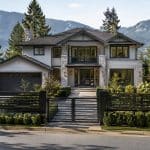

Choosing a driveway gate for a sloped property in North Vancouver is not as simple as selecting a design you like. The direction of the slope, driveway width, space beside the entrance, setback from the street, drainage, snow and debris, and the amount of room available for the gate to move all affect which system will work reliably.
That can be especially useful on North Shore properties where steep approaches, heavy rainfall, leaves, gravel, snow, drainage channels, and uneven pavement can make conventional gate systems more difficult to operate.
However, cantilever gates are not automatically the right answer for every home. A swing gate, telescopic sliding gate, tracked sliding gate, or specialized rising-hinge gate may be more appropriate depending on the site.
What Is the Best Gate for a Sloped Driveway?
For most driveways that rise from the road toward the home, the main options can be ranked as follows:
| Driveway Condition | Recommended Gate | Suitability | Main Reason |
|---|---|---|---|
| Driveway slopes uphill toward house | Cantilever sliding gate | Excellent | Gate travels sideways rather than swinging into the rising pavement |
| Uneven or rough driveway surface | Cantilever sliding gate | Excellent | No ground track is required across the vehicle opening |
| Moderate slope with adequate side space | Automatic sliding gate | Very Good | Horizontal movement avoids most swing-clearance problems |
| Limited side space | Telescopic sliding gate | Good | Multiple overlapping leaves reduce the required storage area |
| Flat or mildly sloped driveway with deep setback | Swing gate | Very Good | Simple mechanism and traditional residential appearance |
| Uphill driveway where sliding is impossible | Rising-hinge swing gate | Site Specific | Special hinges lift the gate as it swings |
| Short urban driveway with little swing clearance | Sliding or telescopic gate | Very Good | Vehicles can wait closer to the gate without interfering with its movement |

Why Standard Swing Gates Can Be Difficult on Steep Driveways
A normal swing gate rotates through an arc. On a level driveway, that movement is straightforward. On a driveway that rises toward the house, however, the bottom of an inward-opening gate can quickly meet the pavement as it opens.
Imagine a double swing gate at the bottom of a steep Upper Lonsdale driveway. If the driveway immediately rises behind the gate, the gate leaves may not have enough ground clearance to complete their opening arc.
Simply mounting the gate higher is not always a good solution. Excessive clearance beneath the gate can affect appearance, privacy, security, and the overall proportions of the entrance.
The Direction of the Slope Matters
Before selecting a gate, it is important to determine how the driveway slopes.
| Slope Type | What It Means | Gate Design Impact |
|---|---|---|
| Uphill slope | Driveway rises from street toward home | Inward swing gates can contact the pavement. Sliding is usually easier. |
| Downhill slope | Driveway drops toward home | Swing geometry and operator loading require careful evaluation. |
| Cross-slope | One side of entrance is higher than the other | Gate alignment, bottom clearance, posts, and foundations become more important. |
| Uneven surface | Driveway contains dips, drainage channels, gravel, or irregular paving | Cantilever systems can avoid problems caused by wheels or tracks crossing the driveway. |
Why Cantilever Sliding Gates Work Well in North Vancouver
A cantilever driveway gate slides parallel to the property line while remaining suspended above the driveway opening. Roller assemblies and a counterbalance section support the gate from one side.
The key advantage is that there is no ground track across the driveway entrance.
That feature is particularly valuable in North Vancouver because a driveway entrance may be exposed to:
- Heavy rainfall
- Leaves and evergreen debris
- Gravel and small stones
- Snow and occasional ice
- Drainage channels
- Uneven paving
- Changes in grade
A conventional tracked gate depends on wheels moving over a track installed at ground level. If the track fills with debris or becomes misaligned, gate operation can suffer. A cantilever gate keeps its primary moving components above the driveway.
How Much Side Space Does a Cantilever Gate Need?
The biggest limitation of a cantilever system is the amount of space required beside the driveway.
Cantilever gates include a counterbalance section behind the visible opening. Manufacturer and industry specifications vary by system, but the overall gate length is commonly around 1.3 to 1.5 times the clear driveway opening.
| Clear Driveway Opening | Approximate Overall Cantilever Gate Length* |
|---|---|
| 10 ft | Approximately 13 to 15 ft |
| 12 ft | Approximately 16 to 18 ft |
| 14 ft | Approximately 18 to 21 ft |
| 16 ft | Approximately 21 to 24 ft |
*Planning examples only. Actual counterbalance length depends on the manufacturer, gate weight, height, frame construction, hardware, operator, and engineering.
This is why measuring the fence line beside the driveway is just as important as measuring the driveway itself.
What if There Is Not Enough Room for a Full Sliding Gate?
Some North Vancouver properties have steep driveways but very limited lateral space because of retaining walls, landscaping, neighbouring property lines, garages, trees, or rock.
In these situations, a telescopic sliding driveway gate may be considered.
Telescopic Sliding Gates
A telescopic gate uses two or more gate panels that move together and overlap as the entrance opens. This reduces the amount of side storage space compared with a conventional single-panel slider.
Depending on the system, a two-panel telescopic gate may require roughly 55% to 65% of the opening width for storage instead of approximately the full width required by a conventional sliding leaf.
For example, a 12-foot entrance may potentially require around 7 feet of lateral storage space with some two-panel telescopic systems, although exact dimensions are manufacturer specific.
The trade-off is complexity. Telescopic systems contain additional rollers, tracks, synchronization components, and moving sections. They also require accurate alignment. A severe sideways slope along the gate’s travel path can make a telescopic system less suitable.
Can You Use a Swing Gate on a Sloped Driveway?
Yes, but the slope has to be evaluated before the gate is fabricated.
A standard swing gate works best when the area through which it opens is relatively level. On an uphill driveway, a specialized rising-hinge gate can sometimes solve the clearance problem by causing the gate leaf to rise as it rotates.
Some commercially available rising-hinge systems are designed to accommodate slopes of up to approximately 14 degrees, subject to gate dimensions, weight, hardware, and manufacturer limitations.
That figure should not be treated as a universal design limit. A gate installer must match the hinge system, motor, gate weight, geometry, and safety requirements to the individual property.
When a Swing Gate Still Makes Sense
A swing gate can remain an excellent option when:
- The driveway is flat or only mildly sloped at the gate location
- There is enough setback for the full opening arc
- The gate can open without interfering with parked vehicles
- There is insufficient fence-line space for a sliding gate
- The architectural style of the property suits a traditional double swing entrance
- The posts and foundations can properly support the gate leaves and operators
Cantilever vs. Tracked Sliding Gate
| Feature | Cantilever Sliding Gate | Tracked Sliding Gate |
|---|---|---|
| Ground track across driveway | No | Yes |
| Good for uneven driveway surface | Excellent | More site dependent |
| Leaves, gravel and snow in track | Not a track issue | Can affect operation |
| Foundation requirements | More substantial support area | Track and support foundation required |
| Side space required | Higher because of counterbalance | Usually lower than cantilever |
| Best for steep North Shore properties | Often an excellent choice | Good when the sliding path can be properly constructed |
North Vancouver Driveway Slope Rules to Know
An important detail for homeowners is that North Vancouver includes two separate municipalities: the City of North Vancouver and the District of North Vancouver. Requirements can differ depending on which side of the municipal boundary your property is located.
City of North Vancouver
The City of North Vancouver Zoning Bylaw includes specific driveway slope provisions. Among them:
| City of North Vancouver Driveway Requirement | Published Standard |
|---|---|
| Maximum slope within first 6.096 m (20 ft) from property line | 10% |
| Maximum slope beyond first approximately 6.1 m | 12.5% |
| Driveway classified as steep for transition requirement | More than 5% |
| Required lower-slope transition area in specified steep-driveway condition | At least 3.048 m (10 ft) at 5% slope or less before meeting the street or lane |
These are driveway regulations rather than automatic-gate specifications, but they demonstrate why grade measurement is an important part of planning an entrance gate.
District of North Vancouver
The District also has detailed requirements for driveway access and steep-site development. Its current servicing bylaw states that typical single-family and duplex driveways must generally be between 3.0 m and 4.5 m wide, while shared residential driveways can be up to 6.0 m.
The District also publishes additional submission requirements for driveways with slopes greater than 20 degrees. These can include a driveway profile, grade information and professional engineering documentation as part of applicable permit work.
If installation of a driveway gate requires changes to the driveway, retaining walls, drainage, electrical service, boulevard, or other regulated work, the project should be checked against the requirements of the correct North Vancouver municipality before construction.
Which Gate Types Are More Suitable in Different North Vancouver Neighborhoods?
There is no public municipal database that reports how many cantilever, swing, or sliding gates are installed in each North Vancouver neighborhood. Therefore, percentages or claims such as “70% of homes in Upper Lonsdale use sliding gates” would not be reliable.
However, North Vancouver’s terrain and housing patterns make certain gate systems more commonly suitable in particular areas.
| North Vancouver Area | Gate Type More Often Suited to the Area | Why |
|---|---|---|
| Upper Lonsdale | Cantilever Sliding | Elevated residential streets and steeper lots make avoiding the swing arc particularly valuable. |
| Canyon Heights | Cantilever Sliding / Automatic Sliding | Upper-slope detached properties often combine grade changes with larger residential entrances. |
| Forest Hills | Cantilever Sliding | Large hillside properties can benefit from trackless operation and premium custom gate designs. |
| Grouse Woods | Cantilever Sliding | Higher elevation, mountain conditions, snow, vegetation and sloped sites favour systems without a driveway track. |
| Upper Delbrook | Cantilever Sliding / Sliding | Elevated detached-home sites frequently make lateral gate movement easier than inward swing clearance. |
| Deep Cove | Cantilever / Telescopic Sliding | Hillside and irregular lots can combine slope with limited space, making compact sliding solutions useful. |
| Dollarton | Sliding / Cantilever | Sloped and view-oriented properties often benefit from automatic gates that do not require a large interior swing area. |
| Blueridge | Cantilever / Sliding | Forested properties can produce significant leaf and debris accumulation, which makes a trackless cantilever system attractive. |
| Seymour Heights | Sliding / Cantilever | Detached homes and varying grades allow sliding systems to work well when adequate side clearance exists. |
| Lynn Valley | Sliding or Swing | Property conditions vary considerably. Flatter entrances may suit swing gates while uphill approaches favour sliding systems. |
| Edgemont | Swing / Cantilever | Larger custom homes may have enough setback for architectural swing gates, while sloped properties may be better served by cantilever systems. |
| Pemberton Heights | Swing / Sliding | Where the entrance grade is moderate and driveway depth is sufficient, both traditional swing and modern sliding gates can work well. |
| Lower Lonsdale | Compact Sliding / Telescopic | Tighter urban properties and shorter setbacks can make space-efficient gate movement more important than slope alone. |
Best Gate Material for North Vancouver’s Climate
Gate movement is only half of the design decision. Material selection also matters in North Vancouver’s wet coastal climate.
| Gate Material | Advantages | Considerations |
|---|---|---|
| Aluminum | Corrosion resistant, relatively lightweight, suitable for automation, modern appearance | Requires correct structural sizing for large openings |
| Powder-Coated Steel | High strength, excellent security, good for large custom gates | Protective coating must remain maintained to limit corrosion |
| Steel Frame with Wood Infill | Combines structural frame with warm residential appearance and privacy | Wood adds weight and requires more maintenance in wet conditions |
| Aluminum Privacy Gate | Low maintenance, lightweight and well suited to modern homes | Solid privacy designs increase wind loading and must be engineered accordingly |
For many automated residential gates, powder-coated aluminum offers a useful combination of low weight, corrosion resistance, appearance, and reduced demand on the gate operator.
Do Not Choose the Gate Motor Before Designing the Gate
One common mistake is selecting an automatic gate opener first and then designing the gate around it.
The correct sequence is the opposite.
The installer should first determine:
- Driveway opening width
- Slope percentage and direction
- Available lateral storage space
- Gate height and desired privacy level
- Gate frame and infill weight
- Expected number of daily opening cycles
- Wind exposure
- Foundation and post conditions
- Electrical access
- Safety sensor and access-control requirements
Only then should the operator be selected and sized for the actual gate.
Automatic Gate Safety on a Sloped Driveway
Automation should include appropriate safety devices rather than relying only on the motor’s resistance detection.
Depending on the system, the design may include:
- Photo-eye safety sensors
- Monitored safety edges
- Vehicle loop detectors
- Opening and closing limits
- Emergency manual release
- Keypads or intercom systems
- Remote controls
- Smart access systems
Sloped sites deserve particular attention because gravity, clearance changes, gate weight, and vehicle positioning can affect how people interact with the entrance.
So, What Is the Best Driveway Gate for a Steep North Vancouver Property?
For a typical driveway that rises from the street toward the house, our first option to evaluate would usually be an automatic cantilever sliding driveway gate.
It avoids the most common problem with an uphill swing gate: the gate leaf hitting the rising pavement. It also eliminates a ground track across the vehicle entrance, which can be valuable on properties exposed to heavy rain, leaves, gravel, snow, and drainage runoff.
If there is not enough room beside the driveway for the cantilever counterbalance, the next options to evaluate are typically a telescopic sliding gate, conventional sliding gate, specialized rising swing gate, or another custom configuration.
The correct solution depends on measurements rather than neighborhood alone.
Driveway Gate Installation in North Vancouver
Lions Gate Railings provides custom automatic driveway gate installation and repair in North Vancouver, including sliding gates, swing gates, and gate systems designed for challenging residential and commercial entrances.
We can evaluate the driveway grade, available opening, fence-line clearance, gate movement, access requirements, and architectural style before recommending a gate system.
Whether your property is in Upper Lonsdale, Canyon Heights, Edgemont, Lynn Valley, Deep Cove, Grouse Woods, Blueridge, Seymour, or another North Vancouver neighborhood, the best gate should be designed around the actual site rather than forcing a standard gate onto a difficult driveway.
For sloped driveways, this site-specific approach can make the difference between an automatic gate that operates reliably every day and one that continually struggles with clearance, alignment, and maintenance.
Sources and Technical Notes
- City of North Vancouver Zoning Bylaw No. 6700: driveway slope, steep-driveway transition and vision-clearance provisions.
- District of North Vancouver Development Servicing Bylaw No. 8145: residential driveway width and access requirements.
- District of North Vancouver driveway requirements for slopes greater than 20 degrees.
- District of North Vancouver GEOweb slope-hazard mapping.
- City of North Vancouver road-slope mapping.
- Cantilever gate manufacturer and engineering guidance regarding counterbalance lengths and trackless operation.
- Rising-gate hinge manufacturer specifications regarding sloped-driveway applications.